
Baldur’s Gate 3 gameplay mechanics and technical analysis
Master the Forgotten Realms with total player agency in the definitive D&D 5th Edition experience.
In the vast landscape of modern role-playing games, few titles manage to capture the sheer chaotic brilliance of a tabletop session quite like Baldur’s Gate 3. Developed by Larian Studios, this colossal title has not only revitalized the CRPG genre but has set a new, almost impossible standard for narrative reactivity and mechanical depth. It is less of a video game and more of a digital dungeon master that genuinely says “yes” to your wildest, most unhinged ideas.
The core conflict places you in the middle of a mind-flayer invasion, infected with a tadpole that promises immense power at the cost of your soul. Yet, the true magic lies not just in saving the world, but in how you choose to do it. Whether you are pushing goblins into spider pits, speaking with the dead to solve murders, or accidentally romancing a bear, the game respects your agency to a degree that feels revolutionary in 2026.
This article serves as your ultimate compendium to Faerûn. We will dismantle the complex D&D 5th Edition mechanics, optimize your technical setup for the demanding third act, and provide meta-defining strategies to conquer Honor Mode. From the nautiloid crash to the streets of the Lower City, this is how you survive the tadpole and ascend to godhood.
🔮 The Core Pillars of the Realm
- Absolute Narrative Agency: Every dialogue choice, failed dice roll, and killed NPC permanently alters the story path, leading to thousands of ending permutations.
- The Action Economy: Combat is won not by damage numbers alone, but by maximizing Actions, Bonus Actions, and Reactions per turn.
- Environmental Sandbox: The world is physical. Water conducts electricity, grease catches fire, and gravity is the deadliest weapon in the game.
- Systemic Reactivity: The game systems interact constantly; stealth, light, sound, and magic weave together to create emergent gameplay moments.
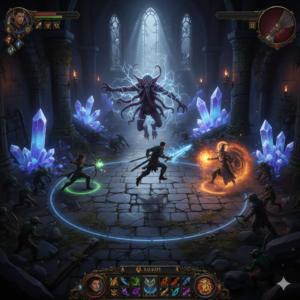
See more in this category: RPG
In this article:
Last updated: February 18, 2026.
Quick definition: Baldur’s Gate 3 is a massive, turn-based CRPG set in the Dungeons & Dragons universe. It combines cinematic storytelling with deep tactical combat, offering unprecedented freedom in character builds and problem-solving.
Who it applies to: This title is designed for fans of high fantasy, tactical strategy enthusiasts, and players who value narrative consequence. It appeals to both hardcore D&D 5th Edition veterans and newcomers willing to learn a complex ruleset for the sake of immersion.
Playtime, Price, and Requirements:
- PC Requirements: SSD is non-negotiable (150GB+). Recommended RTX 3060 / RX 6600 XT for stable 1440p gameplay, especially in Act 3.
- Console/Mobile: Available on PS5 and Xbox Series X/S. Playable on mobile devices via GeForce Now (Ultimate tier recommended for 4K streaming).
- Playtime: A “rushed” main story run takes 60–80 hours. A completionist run easily exceeds 150 hours.
Key takeaways that decide the meta:
- Creative Chaos: The game rewards “cheese” strategies (e.g., barrelmancy) just as much as honorable combat.
- Dice Rolls (RNG): Success is never guaranteed. Learning to fail forward is a critical skill.
- Initiative is King: Acting first in combat is often the deciding factor between a flawless victory and a total party wipe.
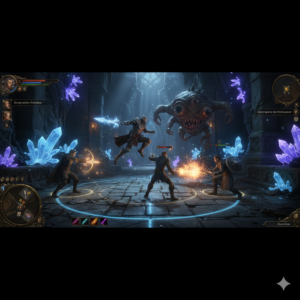
Quick guide to Baldur’s Gate 3
- Control Layouts: On PC, the keyboard/mouse offers precise tactical clicking and inventory management. On Console/Handheld, the “Radial Menu” system is surprisingly intuitive for spell selection but slower for inventory management.
- The Tutorial (Nautiloid): Do not skip the prologue mechanics. It teaches you about elemental surfaces (fire, dipping weapons) and introduces the “Command” spell trick to get a powerful weapon early.
- UI Basics: Your hotbar is your lifeline. Unlock it and organize spells by “Action,” “Bonus Action,” and “Reaction” to visualize your turn economy instantly.
- Progression Priority: Level 5 is the biggest power spike in the game (Extra Attack for martials, Level 3 Spells for casters). Prioritize reaching this milestone before tackling the Underdark or Mountain Pass.
- The “Examine” Feature: Always right-click (or press D-pad Down) to examine enemies. Knowing if a boss is resistant to Fire or vulnerable to Bludgeoning is half the battle.
Understanding gameplay in practice
At its heart, Baldur’s Gate 3 is a simulation of the Dungeons & Dragons 5th Edition ruleset, but adapted for a video game environment where the “Rule of Cool” often supersedes strict adherence to the pen-and-paper manual. The gameplay loop revolves entirely around the **Action Economy**. In most RPGs, you just attack. Here, a turn consists of movement, an Action (your main attack or spell), a Bonus Action (shove, jump, potion, off-hand attack), and a Reaction (opportunity attacks, shield spell).
Mastering the game means squeezing value out of every single one of these resources. If you have a Bonus Action left over and you end your turn, you are playing sub-optimally. You could have dipped your sword in fire, shoved an enemy, or drank a potion. This layer of tactical depth means that a well-optimized party of Level 4 characters can dismantle a Level 6 encounter if they utilize their economy better than the AI.
Furthermore, the environment is a participant in the battle. Larian Studios’ engine allows for physics-based interactions that D&D tabletop rules often abstract. You can destroy a bridge to send enemies plummeting, shoot a chandelier to crush them, or use water spells to freeze a puddle and make enemies slip prone. “Prone” enemies grant Advantage to melee attackers, meaning you roll two dice and take the higher number, drastically increasing your hit chance and critical hit probability.
🔥 Meta-Defining Build Decisions
- The “Tavern Brawler” Monk: By dumping Dexterity and pumping Strength (via elixirs), this build breaks the math of the game, applying double Strength modifiers to attack and damage for unmatched DPS.
- The “Sorlock” (Sorcerer/Warlock): Combining Metamagic (Quickened Spell) with Eldritch Blast allows for machine-gun levels of force damage that pushes enemies off cliffs.
- Critical Path Choices: Siding with Minthara no longer requires slaughtering the Grove (thanks to the “Knock Out” update), allowing you to recruit a top-tier Paladin without losing good-aligned companions like Wyll and Karlach.
- Resource Priority: Never hoard “Elixirs of Hill Giant Strength.” They last until a Long Rest and transform weak characters into titans.
Mechanics that change the outcome
Understanding **Advantage and Disadvantage** is the single most important mathematical concept in the game. Rolling 2d20 and taking the higher (Advantage) is roughly equivalent to a +5 bonus to your roll. Sources of Advantage include attacking from stealth (hiding), attacking a prone enemy, or using spells like “Faerie Fire.” Conversely, fighting in the dark without Darkvision imposes Disadvantage, crippling your hit rate. This makes lighting—torches, spells, glowing weapons—a tactical necessity, not just an aesthetic choice.
The **Concentration** mechanic is another pivot point. Powerful spells like “Haste” or “Spirit Guardians” require the caster to maintain mental focus. If that caster takes damage, they must make a Constitution saving throw. If they fail, the spell ends immediately. In the case of “Haste,” the target becomes “Lethargic” and loses a turn. Protecting your concentration via the “War Caster” feat or “Resilient: Constitution” feat is mandatory for high-level play.
Finally, **Damage Riders** and the “DRS” (Damage Rider Sources) mechanics, though patched and rebalanced over time, still define the meta. Items that add specific damage types (like the Caustic Band adding Acid damage) can trigger other effects (like the Ichorous Gloves applying Noxious Fumes). Stacking these gear synergies allows characters to deal hundreds of damage per turn in the late game.
Strategies pro players actually use
Veterans of the genre utilize **Pre-Buffing**. Before entering a dangerous room, they enter “Turn-Based Mode” manually. This freezes time, allowing them to cast “Bless,” “Longstrider,” and “Mirror Image” without the buff timers ticking down in real-time. This ensures the party enters combat with full defensive layers active, saving precious Actions during the actual fight.
Another pro strategy is **Camp Casting**. Because the game allows you to swap party members freely at camp, you can hire “Hirelings” from Withers, spec them into Clerics or Druids, and have them cast long-lasting buffs like “Aid,” “Heroes’ Feast,” and “Darkvision” on your main party. You then leave the hirelings at camp and venture out with your main squad, fully buffed, without using any of your actual party’s spell slots.
Map Control via **Chokepoints** is essential for “Honor Mode” survival. Instead of running into a room full of enemies, pro players often open a door, fire an arrow to trigger combat, and then retreat behind the doorway. They layer the entrance with “Spike Growth” or “Cloud of Daggers.” The AI is forced to funnel through the kill zone, taking massive damage before they can even reach your tank.
Practical application: The Gameplay Loop
A typical session in Baldur’s Gate 3 is a rhythm of exploration, tension, tactical release, and narrative consequence. The loop is driven by the “Rest” system. You are essentially managing a battery of resources (Spell Slots, Rage Charges, Superiority Dice) that drains with every encounter. The tension comes from pushing your party just one fight further before heading back to camp, balancing the risk of a wipe against the cost of camp supplies.
Implementing a solid workflow prevents the common “save scumming” fatigue and keeps the story moving forward organically. The goal is to treat every Long Rest as a narrative chapter break, checking in with every companion for new dialogue lines that only trigger overnight.
- Pre-Expedition Prep: Apply “Longstrider” (it’s a ritual, costs no spell slots) to everyone. Check inventory weight and send heavy loot to camp.
- Exploration & Dialogue: Move in a group, but ungroup your rogue for scouting. Use “Guidance” (Cleric cantrip) on every single skill check to add 1d4 to your rolls.
- The Engagement: Spot enemies from a distance. Enter stealth. Position your ranged units on high ground. Initiate combat with a surprise attack if possible.
- Post-Combat Looting: Hold the ‘Alt’ key to highlight items. Pick up everything with a gold-to-weight ratio of at least 10:1. Send camp supplies directly to camp stash.
- The Short Rest: Use a Short Rest to heal and recover Warlock spell slots and Fighter maneuvers. Do this twice before considering a Long Rest.
- The Long Rest: When resources are dry, camp. Important: Do not just sleep. Talk to everyone. Pet Scratch. Read books found during the day. This is where the story lives.
Technical details and performance
While Acts 1 and 2 generally run smoothly on a wide range of hardware, the infamous Act 3 (Baldur’s Gate City) is a CPU-bound crusher. The sheer density of NPCs, coupled with the complex scripting of their AI schedules, puts an immense strain on the processor. Even in 2026, mid-range CPUs can struggle to maintain 60 FPS in the Lower City. Enabling “Dynamic Crowds” in the settings can alleviate this by reducing the number of background NPCs.
For GPU optimization, DLSS (Deep Learning Super Sampling) on Nvidia cards and FSR (FidelityFX Super Resolution) on AMD cards are essential for playing at 1440p or 4K. The “Quality” preset is visually indistinguishable from native resolution in most scenes but provides a 20-30% framerate boost. Owners of HDD hard drives must enable “Slow HDD Mode” in the settings, though an SSD is strongly recommended to avoid texture pop-in and 40-second load times.
- Volumetric Fog: This setting is a performance hog. Lowering it to “Medium” or “Low” grants a massive FPS boost with minimal visual impact during exploration.
- Steam Deck: The game is Verified but requires capped 30 FPS and FSR set to “Balanced” for a stable experience. Text size should be adjusted in accessibility settings for readability on the small screen.
- Cross-Save Sync: Larian accounts sync your last 5 saves. Ensure you let the “Syncing” cloud icon finish before closing the game, or you risk version conflicts when switching platforms.
Statistics and scenario reads
The meta of Baldur’s Gate 3 has settled into distinct patterns as players have dissected the mechanics over years of updates. The statistics below reflect the current landscape of class popularity and success rates in the grueling Honor Mode.
These numbers aren’t just trivia; they indicate which classes offer the most consistent tools for survival and which narrative paths players find most rewarding. The dominance of Paladins, for instance, speaks to the value of high Charisma (for dialogue) combined with high burst damage (Divine Smite) in a game that rewards both.
⚔️ Class Pick Rates (Global Stats)
🔄 Meta Shifts (Patch 7 vs Present)
Tavern Brawler Monk: Dominant → Still God Tier (Despite minor nerfs, the accuracy math remains broken).
Ranger (Beast Master): Niche → High Tier (Buffs to companion scaling have made the Bear/Raven viable tanks).
Arcane Trickster Rogue: Weak → Still Weak (The Mage Hand mechanics are too limited compared to tabletop).
📈 Honor Mode Survival Metrics
- 💀 42% of runs end at the Intellect Devourers on the beach (Level 1 lethality).
- 💀 25% of runs end at the Myrkul fight (Act 2 Boss) due to DPS checks.
- 🏆 Only 1.4% of players possess the Golden Dice achievement.
Practical examples of gameplay
✅ The “Pro Play” (Environment)
Scenario: Fighting the Goblin Camp leaders inside the Shattered Sanctum.
The Play: Instead of fighting Dror Ragzlin head-on, the player notices the wooden rafters above the throne. They position Astarion and Gale up high before combat starts. When the fight begins, they destroy the support beams of the braziers hanging from the ceiling, dropping them onto the clustered goblins for massive fire damage. Astarion then uses “Shove” to push any goblin attempting to climb the ladders back down, dealing fall damage and wasting their turns. The player wins without taking a single hit.
❌ The “Noob Trap” (Hoarding)
Scenario: Fighting Balthazar in the Shadowfell.
The Mistake: The player has 45 Scrolls of Fireball, 12 Potions of Speed, and 6 Elixirs of Universal Resistance in their inventory. They decide to “save them for the final boss.” They engage Balthazar with basic attacks and cantrips. Balthazar’s undead army overwhelms the party’s action economy. The player wipes, reloading the save, still refusing to use the consumables that would have trivialized the encounter. They finish the game with an inventory full of unused power.
Common mistakes in Baldur’s Gate 3
Skipping Long Rests: Players fear the “urgent” story warnings and avoid resting. This causes them to miss crucial camp cutscenes that advance companion storylines and romances, effectively breaking quest chains.
Ignoring Verticality: Fighting on even ground is a disadvantage. Always seek the “High Ground” (+2 to Attack Rolls) or use the “Threatened” status to force disadvantages on enemy ranged units.
Underestimating Charisma: Many players treat BG3 as a combat simulator. A high Charisma character (Bard/Paladin/Sorcerer) can talk bosses into committing suicide, bypassing some of the hardest fights in the game completely.
Using “Karmic Dice” Blindly: This setting (on by default) smoothes out RNG to prevent streaks. However, it also increases the chance of enemies hitting *you* (to prevent your dodge streak). High AC builds should turn this OFF.
FAQ about Baldur’s Gate 3
❓ Should I play as an Origin Character or a Custom “Tav”?
For a first playthrough, a Custom Character (“Tav”) is highly recommended. This allows you to experience the fully voiced personalities of the companions (like Shadowheart and Astarion) as party members, which you miss if you play as them.
However, the “Dark Urge” origin is a unique hybrid. It allows for full customization like a Tav but includes a specific, darker personal storyline that is deeply tied to the game’s lore. It is arguably the canonical way to experience the story, but be warned: it contains shocking moments of unavoidable violence.
❓ Is cross-play supported between PC and Console?
As of the latest updates in late 2025/2026, Larian Studios has enabled full cross-platform multiplayer. You can adventure with friends on PS5 and Xbox while playing on PC. Ensure all players are logged into their Larian Accounts to facilitate the connection.
Cross-save is also available, meaning you can upload your save to the cloud on Steam and continue playing on your PlayStation 5, provided you own a copy of the game on both platforms.
❓ What is the level cap, and why is it Level 12?
The hard level cap is 12. In Dungeons & Dragons lore, characters beyond level 12 begin to acquire “world-altering” spells like Wish or Resurrection, which are nearly impossible to program into a video game without breaking the narrative logic.
Despite the cap, progression continues via high-tier equipment. The items you find in Act 3 essentially act as levels 13-20 in terms of power, granting abilities that rival demigods, such as setting your Constitution to 23 or granting flight.
❓ Can I respect/change my class if I make a mistake?
Yes, very easily. Early in Act 1, you will find an undead NPC named Withers in the Dank Crypt. He will join your camp and offer a service to change your class for a mere 100 gold.
There is no limit to how many times you can do this. You can change your stats, class, subclass, and even your appearance (via the Magic Mirror). This encourages experimentation, allowing you to try wild builds without fear of bricking your save file.
❓ Does the “Guardian” character I create matter?
Without spoiling major plot points, yes, the Guardian is a central narrative figure. However, you will not be fighting as them or controlling them directly in combat for the vast majority of the game.
Design them to look however you want, as you will be seeing them frequently in cutscenes and dream sequences. Their visual customization has no impact on their stats or abilities.
❓ How does romance work in BG3?
Romance is based on an “Approval” system. Companions react to your decisions; Shadowheart likes privacy and pragmatism, while Karlach loves heroism and direct action. You must raise their approval rating to unlock romantic dialogue options, usually triggered during the Tiefling Party in Act 1.
Be careful not to lock yourself out. Some characters are monogamous and will force you to choose between them and another lover in Act 2. Others, like Halsin or Astarion (depending on choices), may be open to polyamory.
❓ What happens if a companion dies in combat?
If a companion reaches 0 HP, they are “Downed” and must make Death Saving Throws. If they fail three times or take massive damage, they die. You can resurrect them using a “Scroll of Revivify” or the spell “Revivify.”
If you lose their body (e.g., they fall into a chasm), their soul will appear as a blue wisp at camp. You can pay Withers 200 gold to resurrect them fully intact. However, if a companion leaves the party due to a story decision, they are gone forever.
❓ How long is Act 1?
Act 1 is massive, comprising the Wilderness, the Underdark, and the Mountain Pass. For a thorough player, Act 1 alone can take 20 to 30 hours. It is highly recommended to complete both the Underdark and Mountain Pass for XP and loot before entering the Shadow-Cursed Lands (Act 2).
Leaving Act 1 too early (before level 5 or 6) will make the beginning of Act 2 extremely difficult, as the difficulty spike is significant.
❓ Can I play this game solo (without companions)?
Yes, “Lone Wolf” runs are possible and a popular challenge for veterans. However, unlike Divinity: Original Sin 2, there is no specific “Lone Wolf” perk that buffs you for playing alone. You will be at a severe disadvantage in the Action Economy.
To succeed solo, you must master stealth, hit-and-run tactics, and heavy use of consumables (explosives, potions) to compensate for the lack of party actions.
❓ What is the “Honor Mode” difference?
Honor Mode is the ultimate difficulty. It enforces a single save file; you cannot reload to fix mistakes. If the entire party dies, the game ends (or you can continue in “Dishonor” custom mode). It also makes bosses much harder by giving them “Legendary Actions.”
Additionally, Honor Mode fixes many “exploits” in the damage math (DRS) that work in Tactician mode, forcing players to use legitimate strategies rather than broken damage stacking.
References and next steps
- Daily Grind: Check merchants after every Long Rest/Level Up; their stock refreshes, offering new potions and scrolls.
- Camp Optimization: Stack crates to create high ground for training, or set up an alchemy station near your chest.
- Community Resources: Use the “BG3 Wiki” (bg3.wiki) for accurate drop tables, as the Fextralife wiki often contains outdated EA (Early Access) info.
- Build Planning: Use online character planners to map out your Feats and multiclass breakpoints before committing levels.
Lore and development basis
Baldur’s Gate 3 is the culmination of Larian Studios’ decades of experience with the Divinity engine, adapted to the strictures of the Forgotten Realms license held by Wizards of the Coast. The game runs on the Divinity 4.0 engine, which allows for the unprecedented level of systemic interaction and verticality seen in the game.
The narrative is deeply rooted in Dungeons & Dragons 5th Edition lore, specifically following the events of the tabletop module Baldur’s Gate: Descent into Avernus. Understanding the hierarchy of devils, the nature of Mind Flayers (Illithids), and the pantheon of gods (Shar, Selûne, Mystra) provides immense context to the story, though the game does an excellent job of onboarding new players through environmental storytelling and books.
For official updates and patch notes, refer to the Official Larian Studios Website or the Wizards of the Coast portal.
Final considerations
Baldur’s Gate 3 is a masterpiece not because it is perfect, but because it is uncompromising. It demands your attention, rewards your curiosity, and punishes your carelessness in equal measure. It restores the “Role” in Role-Playing Game, asking you not just to press buttons, but to embody a character in a living, breathing world.
Whether you ascend as a benevolent hero or burn the Sword Coast to the ground as a disciple of Bhaal, the journey is uniquely yours. Embrace the dice, respect the gravity, and remember: in Faerûn, knowledge is just as powerful as a fireball.
Key Takeaway 1: Master the Action Economy; more actions equal victory.
Key Takeaway 2: Long Rest often to experience the full narrative depth.
Key Takeaway 3: Don’t fear failure; a failed dice roll often leads to a more interesting story.
- Check your gear: Ensure everyone is proficient in what they are wearing.
- Manage your alchemy: Turn those gathered herbs into potions before tough fights.
- Save often: F5 is your best friend, even if you try not to abuse it.
This content is for informational purposes only and does not replace official game guides or manual instructions.